Showing posts with label Systematic Theology. Show all posts

Thursday, January 27, 2011

Humanity's Fall

I just got a new book, "The Christian Faith" by Michael Horton (published by Zondervan). I was reading something very interesting, a quote from C.S. Lewis (God in the Dock, Grand Rapids: Eerdmans, 1970, 216-17), and thought you might find it interesting as well (pp.432-434).

"You are always dragging me down," said I to my Body. "Dragging you down!" replied my Body. . . . "Who put an end to all those angry and revengeful thoughts last night? Me, of course, by insisting on going to sleep. Who does his best to keep you from talking too much and eating too much by giving you dry throats and headaches and indigestion? Eh?" "And what about sex?" said I. "Yes, what about it?' retorted the Body. "If you and your wretched imagination would leave me alone I'd give you no trouble. That's Soul all over; you give me orders and then blame me for carrying them out."
Horton continues off of this quote and says,

The biblical view [of human sinfulness] is constantly challenging our attempts to exonerate ourselves by fixing the blame on something outside of ourselves. If we cannot deflect sin to society, we will press charges against our family; if this is inadequate, we will indict our own body as if it were exterior to our real self. The soul flees the approaching footsteps of divine judgment by withdrawing within, protesting its divinity and purity.

. . . The inner self is not the innocent spark of divinity or island of purity, but is the fountain from which every act of violence, deceit, immorality, and idolatry flows out through the body and into the world.

. . . Captive to sin, "in Adam," we are nevertheless willing accomplices to our own imprisonment (Ro 5:12). Only when God seizes us and liberates our captivity are we truly free to be the human beings that we are (Jn 8:36).

God, seize and liberate us!

Thursday, December 02, 2010

Genesis 1:1 & The Triune God

I just picked up Driscoll's "Doctrine" book to read, and in the first chapter I came across something that was very interesting and new to me. Because I don't make a mistake in the communication process, the section is quoted before (with a minor commentary of my own). But, before I do, I did want to encourage you (especially men) to pick up this book. As men we have a high calling of being responsible to train and exhort our families and people in our churches. We need to point them to God and we need to be in the Word - knowing God more and more so we can be saturated with Him. Regarding this book, James MacDonald (Senior Pastor at Harvest Bible Chapel in the Chicago area) said, "A challenging yet easy-to-understand guide to the major doctrines of Scripture. I commend it to you as a companion to your study of God's Word."

So, without further adieu, here's the quote:

The opening lines of Scripture reveal God in a most surprising way:
In the beginning, God created the heavens and the earth. The earth was
without form and void, and darkness was over the face of the deep. And the
Spirit of God was hovering over the face of the waters.

We see both God the Father and the Spirit of God involved in creation.

It gets even more interesting when we look at how ancient Jewish rabbis understood this passage as they did their interpretative translation of the Hebrew Bible in Aramaic, the common language of the people. they did a word study of "beginning" (re'shit in Hebrew) and found that it is used in synonymous parallelism with the Hebrew word for "firstborn" (bekor in Hebrew) four times in teh Old Testament. This would mean that the two words, "Beginning" and "firstborn," can have the same meaning. Thus, their translation of the opening words of the Bible includes both words:

In the beginning, by the firstborn, God created the heavens and the earth.
The earth was without form and void, and darkness was over the face of the
deep. And the Spirit of god was hovering over the face of the waters.

In this important translation, predating the birth of Jesus Christ by approximately two hundred years, we find three divine persons-the Firstborn, God the Father, and the Spirit-at work in creation.
This is me speaking now. You could stop at this point and say, "Well, this is Jewish Scripture that may or may not be inspired. It's just their translation." That may be the case, but get this next point.

Paul reflects this pre-Christian Trinitarian understanding when he describes the Son as "the firstborn of all creation. For by him all things were created, in heaven and on earth, visible and invisible, whether thrones or dominions or rulers or authorities-all things were created through him and for him."
Thoughts? Reflections? I'd love to hear them!

Thursday, November 18, 2010

Jesus in Isaiah 6

When was the last time you read Isaiah 6? For me, this passage is familiar. It's one of those passages that I hope will hit me more and more. I desire that I would be filled with the greatness and awe of God's majesty, and this passage shows me just how majestic God is.

Recently I was listening to to our Vintage Jesus series that the teens in our youth ministry are going through, and Mark Driscoll brought up a point that I had never seen before: The description of God in Isaiah 6 is the description of Jesus. As a conservative evangelical Christian, I know that God is Triune, but it just hit me more to realize how closely related the Persons of the Trinity are when I heard Driscoll share this verse:

Isaiah said these things because he saw his glory and spoke of him. - John 12:41
John is referencing Jesus in this verse. John is saying that Isaiah saw Jesus' glory and hence spoke of Him. At what point in time did Isaiah see Jesus' glory? It's rehearsed in Isaiah 6.

In the year that King Uzziah died I saw the Lord sitting upon a throne, high and lifted up; and the train of his robe filled the temple. Above him stood the seraphim. Each had six wings: with two he covered his face, and with two he covered his feet, and with two he flew. And one called to another and said: "Holy, holy, holy is the LORD of hosts; the whole earth is full of his glory!"
Jesus is not only the humble servant, but He is King of kings. He is the Holy Lord. He is the Mighty God whom seraphim continually worship. He is all-powerful. And, for anyone who trusts Him, He is their Savior!

Monday, November 05, 2007

Living Theology

This is a recent blog post that I found (the link to the original post is in the title). I hope it is encouraging to your heart!

I have read about and heard of people who cringe at the idea of ‘studying’ God, as if learning theology is clinical, like some kind of divine autopsy. But Scripture consistently calls us to grow in our study and knowledge of God and says there is an important connection between what we know about God and how we should live.

I recently spoke at a retreat entitled – "The Ology." The idea was that of all our learning, studying and knowing God is most critical to all of life. God is the most important thing we can study, the most important "ology". In 2 Timothy 4, Paul presents this as he talks about the importance of “being trained” in “good doctrine." He directly connects theology to growing in godliness. Theology is not just book knowledge or head knowledge, it is heart and life knowledge. It is not just about what you know about God, but living in a way that is dictated by what you know. In their book, Let the Reader Understand, Dan McCartney and Charles Clayton say, “Doctrine has not been known properly until it has been lived out.” Wayne Grudem agrees in his definition of Systematic Theology when he says, “Defining Systematic Theology to include 'what the whole Bible teaches us today' implies that application to life is a necessary part of the proper pursuit of systematic theology (emphasis mine).” For Paul, having “good doctrine” is important because it causes us to grow in godliness – it affects the way we live.

Then in the familiar passage to not allow people to look down on Timothy’s youth, Paul calls him (and us) to “set the believers an example in speech, in conduct, in love, in faith, in purity” (1 Tim 4:12). Paul says when we believe rightly it should cause us to live in such a way that we are examples to other believers. There should not be anyone looking down on us because of our age, but rather they should find themselves impressed, challenged, encouraged, and inspired by our speech, conduct, love, faith and purity. Paul is telling Timothy that even though he is young, his pursuit of God and passion for the Savior should be an example for those around him. And, in like manner our pursuit of God and passion for the Savior should be an example for those around us.

I see this everyday in the college students I serve.

Colin is a guy I know who is determined to spend time daily in the scriptures to study hard and know God. When I see him lead a morning prayer meeting on campus at 7am every Wednesday, I know he is not just doing it because he is a morning person. He knows that in the gospel, Christ has not only redeemed him but given him access to the Father in prayer. He knows God gives us prayer as an essential part of life and that God will answer our prayers (1 Thes 5:16-18; John 14:13). And so he prays and leads others to pray. When he takes a few hours on a Tuesday evening going out on campus to specifically start conversations about the gospel, it is not because he is finished all of his studying or has nothing better to do. He knows that eternity is at stake for students on the campus of West Chester University—that Christ died to save them in their rebellion and that hearing the Gospel can bring them from death to life (Rom 1:16-18; 2:5; 5:8 ;1 Cor 1:17-24). He does these things because of what he knows about God!

Another guy, Mike, has done a great job of honoring his Dad as he makes decisions about everything from jobs to school to how to spend his free time. As Mike looks at the gospel he realizes that Christ’s death for his sin frees him to honor God by honoring his father and provides him with the grace to do so. Even when his Dad’s perspective has differed from what Mike was hoping, it has not only been Mike’s keen sense of humor that has helped him to cope. Mike has also been able to see how his heart, though free from the dominion of sin, is still influenced by remaining sin. Knowing this helps him to seek God’s grace to be humble and receive input from his dad. This has served Mike all the more in his relationship with his girlfriend as he is not only open to his own father’s perspective, but also the thoughts and perspective of his girlfriend’s father.

Eszter is an au pair from Hungry. As she grown in her understanding and experience of the gospel, she sees how Christ’s blood has purchased her to be included among the people of God. Becoming more involved in her local church, she is constantly telling me how she finds joy in the word of God preached, in her friendships and in seeking to serve. Because coming to America can be a big adjustment, Eszter is often contacted by other au pairs who are moving to the Philadelphia area. What Eszter has learned about God in the gospel gets lived out not only in her own involvement, but in her enthusiasm to bring other au pairs to experience the same thing. Because she knows God has called her to be part of a local body of Christians, she wants others to experience the blessings of this kind of community.

Like so many other students I serve, what Colin, Mike and Eszter have learned in studying God (theology) has affected the way that they live (i.e. prayer, submission to parents, commitment to a local church). And this is an example to me and to our whole church!

The same needs to be true in every area of our lives: the way we run after godliness, the way we choose entertainment, the way we serve a friend, the things we say or don’t say, the way we give money or time to help those who are hungry, or sick or in need. How we live must be rooted in what we know about God. Knowing God will affect the way we live. Getting to know God is not about performing a divine autopsy; rather, it is the Living God making Himself known to us and then changing us by his grace to live out what we know. Study hard.
_______

Joseph Stigora serves Covenant Fellowship Church as the College-Age Pastor as well as by overseeing music and leading worship.

Tuesday, October 10, 2006

A fool says.... (Personal Studies, Part 2)

The fool says in his heart, "There is no God...." (Ps. 14:1).

In my studies, I came across a funny story that Grudem recounts that I thought you'd like to read. Enjoy!

Several years ago I was a passenger in a car with several friends, including a young woman who in conversation was firmly denying that she had any inner awareness of God's existence. Shortly thereafter the car hit a patch of ice and spun around in a complete circle at high speed. Before the car came to rest in a large snow bank (with no serious damage) this same woman could be heard distinctly calling out, "Lord Jesus, please help us!" The rest of us looked at her in amazement when we realized that her agnosticism had been disproved by words from her own mouth (Systematic Theology, Grudem, pp 141-142).
I hope that you enjoyed that story.

Thursday, October 05, 2006

Personal Studies


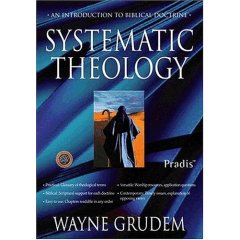
Currently in my studies, I'm trying to read through Grudem's Systematic Theology. So far it has been an encouraging read. However, in order to learn more, I have decided that it would be beneficial for me to write about what I've learned in the chapters/sections that I've read.

So, here I go!!!

Since I've waited too long to write about the first several chapters of the book, I'm going to simply quote my personal highlights from my reading. By the way, this all is on the Doctrine of the Word of God

"'You shall not add to the word which I command you, nor take from it...' (Deut. 4:2; cf. 12:32). In order to have disobeyed such a specific command, Joshua must have been convinced that he was not taking it upon himself to add to the written words of God, but that God himself had authorized such additional writing" (p. 55).

- I don't know about you, but I've never thought about this point. No wonder there were so many Jews that just believed in the Torah! Also, one question comes to mind. How do we then know that there is going to be NOTHING added to the Scriptures after Revelation since the wording of Revelation is basically the same as this? Just asking for us to think. :)

"Even in Peter's statement just quoted, the context is an appeal to the teachings of Paul's letter, which Peter's readers had read and understood (2 Peter 3:15). In fact, Peter assigns some moral blame to those who twist these passages 'to their own destruction.' And he does not say that there are things impossible to understand, but only difficult to understand" (p. 105).

- The reason I love this point so much is that it shows that just because it's "difficult" doesn't mean it isn't necessary. We need to be giving ourselves to the study of the Word! And sometimes (if not many), it is difficult. But, if we're pursuing God rightly, it's a delightful task.

"Instead, whether he is speaking to scholars or untrained common people, his responses always assume that the blame for misunderstanding any teaching of Scripture is not to be placed on the Scriptures themselves, but on those who misunderstand or fail to accept what is written" (p. 106).

- So, these "difficult things" can be understood by the "common people"?! YES! For anything spiritual can only be understood by the SPIRIT! The Scriptures are clear. We're the ones with sin.

"To neglect regular reading of God's Word is as detrimental to the health of our souls as the neglect of physical food is detrimental to the health of our bodies" (p. 118).

- Ah, the stab of gracious conviction.

With this, I will end my post. There are a lot of quotes here. I hope they're at least somewhat beneficial to you. Thanks for reading.

Have a blessed day.