Showing posts with label The Bible. Show all posts

Thursday, April 28, 2011

Is God Holding You Back

Last week I was reading in Numbers, and a certain passage stood out to me. This passage is found in the story of Balak and Balaam. King Balak had asked the false prophet Balaam to curse Israel. Through the process, God grabs Balaam’s heart and Balaam refuses to submit to Balak’s request. As a result, we read the following:

And Balak’s anger was kindled against Balaam, and he struck his hands together. And Balak said to Balaam, “I called you to curse my enemies, and behold, you have blessed them these three times. Therefore now flee to your own place. I said, ‘I will certainly honor you,’ but the LORD has held you back from honor.” (Numbers 24:10-11 ESV)

As I’ve thought about this passage over the past few days, I’m reminded that non-Christians may often say to Christians, “The LORD has held you back from honor.” When Christians have opportunities to sinfully make a quick buck or to indulge in an age-old dream that would draw them away from God, people (even our own flesh) might say, “The LORD has held you back from honor.” These are words that, at the heart, are as old as the first temptation itself. Think back to the serpent’s conversation with Eve in Genesis 3. He tries to get Eve to believe that God is withholding some greater blessing. Eve takes the bait. She sins. She realizes the dire circumstances into which she ran. Balak is assuming and sharing that same lie, but Balaam rejects it when he says, “Did I not tell your messengers whom you sent to me, ‘If Balak should give me his house full of silver and gold, I would not be able to go beyond the word of the LORD, to do either good or bad of my own will. What the LORD speaks, that will I speak’? (Numbers 24:12b-13 ESV).

Balaam realizes something profound. God’s word and way is worth more than a house filled with silver and gold. To put it another way, “

For what does it profit a man to gain the whole world and forfeit his soul? (Mark 8:36 ESV)

and

. . . whoever loses his life for my sake and the gospel’s will save it. (Mark 8:35b ESV)

Anyone who surrenders to Christ will find true gain, and the gospel enables us to see this clearly. Ultimately, while Balaam’s example is nice, it’s not his example that will fuel us the rest of our days. (Keep in mind that Balaam's own experience did not maintain himself.) Christ’s sacrificial life, death and intercession will fuel us. Do you remember what the people said to Jesus while he was on the cross?

He trusts in God; let God deliver him now, if he desires him. For he said, ‘I am the Son of God.’”
(Matthew 27:43 ESV)

The accusation towards Jesus is very similar to that of Balak’s statement. In essence they said, “God probably does not care for you.” As Christians, we know otherwise. The Scriptures say, “looking to Jesus, the founder and perfecter of our faith, who for the joy that was set before him endured the cross, despising the shame, and is seated at the right hand of the throne of God” (Hebrews 12:2). Jesus despised the shame of the cross yet he looked forward to the greater joy that was ahead of him – sitting at the right hand of the throne of God!

If you find yourself right now feeling weak, look to Christ. The next time your flesh or somebody else says that God is holding you back, remember that he died to set you free. Trust him and look forward to the hope that is set before you. Then, you can say with the other saints through the ages that God is your treasure and you wouldn’t trade him for all the riches of this world!

Monday, January 03, 2011

When God Denies Deliverance, Part 2

If you haven't read the first interpretation of this passage, click here. This is the second of a two-part series on God's radical deliverance and also his withholding of deliverance.

In this story, the words of God, "'Go and cry out to the gods whom you have chosen; let them save you in the time of your distress'" (v. 14) must have rung with horror in the ears of the hearers. The Israelites just cried out for mercy and they received judgment. To a someone like myself who still faces sin daily, it is this sober phrase that tells me that God can do whatever He pleases and is in no way obligated to do what I tell Him to do.

But, what's the end of this story? We read one interpretation, but here's another one - one with which I'm more apt to agree (although the other interpretation is entirely feasible).

The Israelites response to God's words are the following, "'We have sinned; do to us whatever seems good to you. Only please deliver us this day'" (v. 15). The following verse goes on to say, "So they put away the foreign gods from among them and served the LORD, and he became impatient over the misery of Israel.

While it is entirely possible that their repentance was fake, and the writer of the book of Judges was merely explaining external religious conformity, I tend to think that's not the case. These words are too specific in detailing how the people of Israel responded. It seems like there really was repentance. They served the Lord and got rid of the foreign gods. And, the passage says that God became impatient over the Israelites misery. What I take that to mean is that God had pity on the people of Israel in their state of misery. He desired to deliver them.

The applications from this passage that I see are the following:

  1. God can do whatever He pleases. In judgment, He is glorified. In extending forgiveness, He is glorified. Yet, in this passage, "mercy triumphs over judgment" (James 2:13).
  2. People who cry out to God for forgiveness don't demand forgiveness. The people of Israel knew that the sobering statement from God was completely justified. Yet, they entrusted themselves to Him and sought after His mercy - even though that mercy was not verbally offered.
  3. Repentance leads to change. The Israelites put away their gods and served the Lord. No change, no repentance.
  4. Repentance doesn't mean perfection. This might seem to contradict #3, but I believe it is more of a healthy balance. Even though the Israelites put away their gods, that didn't mean they did everything right. After this, in chapter 11, they chose what seems to be the wrong judge. This doesn't mean they didn't repent in the story in chapter 10. I believe this simply means that they are experiencing the Romans 7 reality.
In all of this, we see a God who fulfills His promise of Romans 10:13 - "For 'everyone who calls on the name of the Lord will be saved.'" God, through Christ, freely grants forgiveness to those who know they do not deserve it and radically changes them by His grace. Although that change may come slowly, God's people will continue to grow and seek Him so that sin is more abhorred and God (and His righteousness) will be more adored.

Wednesday, December 29, 2010

When God Denies Deliverance

This morning I was reading in Judges and I came across the familiar situation of the Israelites. They had disobeyed God. God punished the Israelites. The Israelites cry to the Lord for mercy.

But, this time the situation is different. In Judges 10:13, God says, "Yet you have forsaken me and served other gods; therefore I will save you no more. Go cry out to the gods you have chosen; let them save you in the time of your distress."

This seems like a harsh response. Doesn't the Bible say that everyone who calls on the name of the Lord will be saved? What happened in this situation?

There are at least two interpretations of this passage. Both of which speak a broader biblical truth. Yet both of the passages lead us to different conclusions about this specific scenario.

I'll give you one interpretation today:

God denies deliverance to Israel because they're really not repentance. They may be sorry about what they've done from a physical perspective, but they're not sorry for what they're done by denying God.

Therefore, God tells them to run to their gods. Obviously there's some harsh sarcasm here. God knows that these gods will never deliver them. These gods got them into this mess, and they will continue to mess them up all the way to hell.

Yet, the people of Israel respond to God by saying, "We have sinned; do to us whatever seems good to you. Only please deliver us this day" (v. 15b).

This looks like real repentance. The problem is that immediately after this, they pick a judge who doesn't seemed to be blessed by God. He even commits an abomination by sacrificing his daughter to God.

So, was there real repentance in Israel? This interpretation says no.

But, my question goes back to God saying that He will not save them anymore (v. 13).

Do you realize that apart from God's grace, this statement is true for everyone? Those who don't have Christ have no guarantee of temporal and/or eternal salvation. Yet God, in His abundant grace, looks beyond this decree and decides to save Israel again and again after this incident. Even when there seems to be no hope - maybe even precisely at that moment where we feel as though all hope is gone - God brings rescue.

God didn't stop bringing judges. And, finally, God allowed for kings. Ultimately God brought Jesus - the Great Rescuer. Mercy triumphs over judgment. And, while God is glorified in judging people according to their sins. God is also glorified, thankfully so, for forgiving sins!

Be thankful that God didn't stop at judging you by your works. Be thankful God judged you according to Christ's work!

Monday, October 11, 2010

Bible Learning

I've been doing a different type of Bible reading plan. As a result of this, I'm reading several chapters a day from various books of the Bible. It's been a really awesome to see how the Bible really is interwoven in its theme of God's salvation!

Check it out. You might like it, too!

Wednesday, September 08, 2010

Side Bar: Bible Reading 101

How do you read your Bible?

Do you look for the moral of the story? Are you actively seeking to find out how you can become a better you, and live a more victorious Christian life?

Over the past week I have had the opportunity to talk to two people about Bible-reading. One person attends our church and the other person walked in our church to ask for help. With both of these people I was able to talk to them about how to approach the Scriptures.

It's interesting because we are all so prone to read the Scriptures through a "moral-of-the-story" lens. However, if you start reading in Genesis, you quickly find that all of these "godly" people weren't very moral at times. In fact, they failed BIG time. Do we really want to follow their example? I mean, even Moses, the most meek man we know of, murdered a guy.

So, what is the point of Scripture? Answer: God and His rescue plan. If Scripture is primarily about people and how to make people better, then we can completely forget about God. In that mentality, the Bible has just become another manual like any other religious book, exercise program or self-help project. No, the Bible is primarily about God, His character and His beautiful plan.

How does that change the way you read the Bible? Well, instead of reading it as a self-help motivational manual, you begin reading by asking this question, "What does this teach me about God?" Secondly, I would add that you must ask this question, "How is this pointing to Christ?" Jesus says in Luke 24:27 that he is the point of it all:"And beginning with Moses and all the Prophets, he interpreted to them in all the Scriptures the things concerning himself" (ESV).

You might say, "Wait, you didn't give these people any real advice. If they don't get any practical application, then they're never going to become good." But, here's the reality of the situation. They can become good without becoming godly. I firmly believe that if someone truly knows God, they want Him to define them. And, how is He going to define them if they only look for the moral of the story and they don't look to God in the story.

A boyfriend loves his girlfriend not by reading her letters for the moral of the story. Instead, he reads her letters and loves her more. As a result, he lives that love out for her in greater ways. Shouldn't that be similar with how we view God? Instead of looking to all God requires, we look to God, become amazed with Him and all that He has done through and because of Christ. As you continue to be amazed with Him, you are defined by Him and your life is changed from one degree of glory to another.

So, can I encourage you to read your Bible that way? Off the bat, you know that you are in need of a Savior daily. So, ask this to yourself, "What does this say about God and how does this point me to Jesus?"

Tuesday, April 28, 2009

Opening Eyes Through The Word

Today I've been awakened to more of the Word, and I want more of it. I feel as though I'm seeing glimmers of light through Scripture, and I pray that the Lord would open my eyes to greater degrees.

I feel what the Psalmist wrote in Psalm 119:18, 27

Open my eyes, that I may behold
wondrous things out of your law

Make me understand the way of your precepts,
and I will meditate on your wondrous works.

What I want to understand more of is the gospel. I want to know the power of Christ and the grace of Christ! After I had read these verses and prayed a little, I heard the words to this song playing on my laptop. I pray that the Lord would grace me more and more by opening my eyes to behold the "wondrousness" of the truths communicated in this song. And, I pray that he would do that as he enables me to seek him through the Word.

Behold Our God

Over land, sky and sea
Over man's great thoughts and dreams
God sits high on His throne
Ruling history.
Nations rage, wars unfold
Men seek power they cannot hold.
God regards their strength with scorn -
Less than nothing.
So when I fear what I don't understand
I'll trust the One who holds the world in His hands.

Behold our God, Sovereign and good
Matchless in power, the King over all the earth
Fear not, my soul. Trust in his plan.
Over all the world, God reigns.
Behold our God!

Over sin's curse on me
Over law's I could not keep
God the Judge has declared all my debt's relieved.
Sin remains close at hand
Pressing in with its demands.
But in my Savior's risen life I find victory.
So when I'm faced with guilt and sin's domain
I'll trust the One who's death has broken my chains!

(from Lu, Sovereign Grace Music)

Thursday, October 05, 2006

Personal Studies


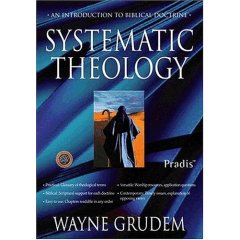
Currently in my studies, I'm trying to read through Grudem's Systematic Theology. So far it has been an encouraging read. However, in order to learn more, I have decided that it would be beneficial for me to write about what I've learned in the chapters/sections that I've read.

So, here I go!!!

Since I've waited too long to write about the first several chapters of the book, I'm going to simply quote my personal highlights from my reading. By the way, this all is on the Doctrine of the Word of God

"'You shall not add to the word which I command you, nor take from it...' (Deut. 4:2; cf. 12:32). In order to have disobeyed such a specific command, Joshua must have been convinced that he was not taking it upon himself to add to the written words of God, but that God himself had authorized such additional writing" (p. 55).

- I don't know about you, but I've never thought about this point. No wonder there were so many Jews that just believed in the Torah! Also, one question comes to mind. How do we then know that there is going to be NOTHING added to the Scriptures after Revelation since the wording of Revelation is basically the same as this? Just asking for us to think. :)

"Even in Peter's statement just quoted, the context is an appeal to the teachings of Paul's letter, which Peter's readers had read and understood (2 Peter 3:15). In fact, Peter assigns some moral blame to those who twist these passages 'to their own destruction.' And he does not say that there are things impossible to understand, but only difficult to understand" (p. 105).

- The reason I love this point so much is that it shows that just because it's "difficult" doesn't mean it isn't necessary. We need to be giving ourselves to the study of the Word! And sometimes (if not many), it is difficult. But, if we're pursuing God rightly, it's a delightful task.

"Instead, whether he is speaking to scholars or untrained common people, his responses always assume that the blame for misunderstanding any teaching of Scripture is not to be placed on the Scriptures themselves, but on those who misunderstand or fail to accept what is written" (p. 106).

- So, these "difficult things" can be understood by the "common people"?! YES! For anything spiritual can only be understood by the SPIRIT! The Scriptures are clear. We're the ones with sin.

"To neglect regular reading of God's Word is as detrimental to the health of our souls as the neglect of physical food is detrimental to the health of our bodies" (p. 118).

- Ah, the stab of gracious conviction.

With this, I will end my post. There are a lot of quotes here. I hope they're at least somewhat beneficial to you. Thanks for reading.

Have a blessed day.